Today I sat and listened to graduation speeches. I listened to girls, first and second in a class of over 500 students practice the speeches they will give to their classmates on the football field a few months from now. It is an honor and a privilege to speak at graduation, one that these girls earned by taking the hardest classes and still managing to get the best grades.
So why is it that both girls took their carefully worded speeches, and swallowed the back half of every sentence? Why did they drop their eyes and their voices at the exact moment they had the most powerful thing to say? Surely they knew they were doing this. We are talking about the two smartest girls in the school.
When they left the AP history teacher who is also on the judging panel remarked to me that he has a brilliant student who is constantly apologizing for saying smart things in class. He told me that even as recently as yesterday he had gotten agitated at this bizarre habit. Why would she apologize for saying smart things?
As he heard me talk to the girls about their bizarrely similar habit, he understood the pattern that had been happening in his classroom for as long as he had been teaching.
________________________________________________________________
It was my freshmen year of college in my first week of classes that she said it to me. It is an interaction that has moved across me like sandpaper scrapping away the bits that don’t belong. This one interaction continues to shape who I am and how I present myself. I was meeting with Mary, one of my speech coaches, about the events I was working on and what she thought my strengths were. Mary can see in and through people almost as soon as she has registered where they are standing. “You know that cute thing you do, where you up-end your sentences?” “Yeah!” I chirped upwardly, attempting to be adorable and disarming. “Yeah” she inflected downward, turning it in to something with power. “I am going to beat that out of you.”
And she did. Four years of speech coaching where every up-speak was questioned. Every time I threw away a line that mattered, it was picked back up and handed to me. Here, try that one again. Every sentence that came out of my mouth, my coaches wanted to know, did I really mean that? If it matters, say it like it matters. I learned which stories mattered most to me, and I learned how to tell them like they were important, to not apologize for them.
________________________________________________________________
I am in the eighth grad and not quite as ugly as I was in the seventh. My poorly chosen bowl cut has since grown into a bob and the retainer (weirdly enough colored like the american flag…why did I choose that? Why was that even a choice?) the size of my fist has been replaced with discreet upper and lower braces. (Perhaps not stand alone discrete, but comparatively there isn’t even a contest.) I am no longer mistaken for a boy. This does not mean that boys are interested in me. They aren’t, even on the days where my skin is mostly clear.
My friend with the perfect bone structure is trying to help. Boys have been chasing her around since we played with the plastic zoo in the church nursery. “You know,” she tells me, flipping her stylish haircut her mother won’t yet let her highlight, “boys would like you better if you didn’t act so smart. Stop answering all the questions. Say you don’t know.” I explain to her that I am so smart, I do know all the answers, I am not going to pretend I don’t know something I do. I tell her that I am not interested in boys liking me if they can’t like me for being so smart. This is a huge lie. I am a 14-year-old girl. Of course I want the boys to like me, even if I have to pretend to be stupid. But I cannot understand why they don’t like me smart.
________________________________________________________________
I am standing at the doorway of my mother’s bathroom. She is putting on mascara and lipstick, Wine with Everything. She is reading my report card where all is proficient. She flips the card over to the back where my teacher has written her comment in cursive pen I am not yet fluent in. My mom reads the comment, about how capable and ready to move to the next grade I am and the part that comes after the but….”But Abby is very outspoken.”
I ask my mom what that means, outspoken. Why did someone assign that word to me? She perses her lips and blots the extra lipsitck. “Well, it means when you have something to say, you make sure to say it.” I scoff to the best of my 9 year old ability. “I don’t think that is a bad thing.” She smiles at me, sees me. “It’s not.” I didn’t get the star girl award that year. That was for my friend who was a little more reserved. My mom told me she didn’t care, but I did. At least a little bit.
________________________________________________________________
I’ve noticed recently that I use mildly negativ adjectives to describe my girls. Hilarious, naughty, audacious. Endearing words, but not totally positive. I am far more likely to tell the stories of them growling, pretending to be monsters and chasing each other, or the stories where they find the patch in the yard where the grass hasn’t grown and I find them literally rolling in the dirt.
I recoil a little at words like sweet, nice, good. It isn’t that I don’t think my girls are those things. It isn’t that I don’t appreciate it when other people call out the goodness, the sweetness, the kindness they see in my girls. It is simply that I know how those words can draw a box around a person. I know how comfortable those boxes can feel, how a person will shrink herself up to stay in them, contort her words, contort herself.
I don’t want my girls to think that they have to be “a good girl” in order to be good. I know how often people throw those words around to mean pipe down, smile for the camera, don’t make waves. I know how it feels when someone tells you, you would be more attractive, easier to stomach, better somehow with less opinions. I know how the world feeds you those lies, and how sometimes you swallow them, even if you are being fed truth at home.
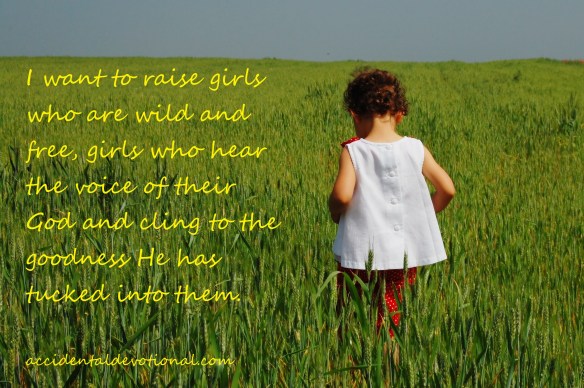
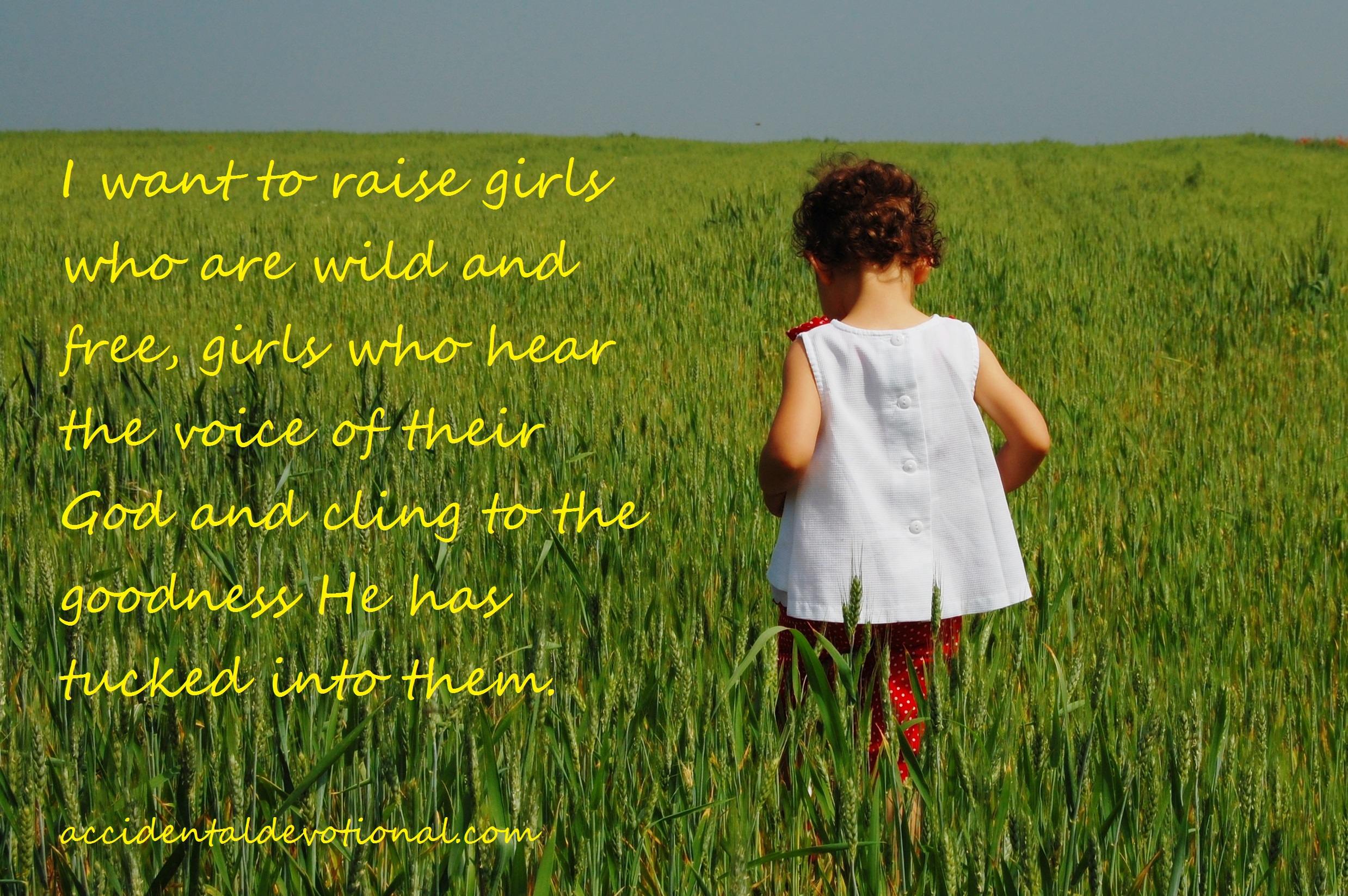
I don’t want to raise good girls. I want to raise girls who are wild and free, girls who hear the voice of their God and cling to the goodness He has tucked into them, and oh how His goodness overflows from their little hearts. But I hope that they aren’t good girls. I hope they are simply too out spoken for that. Turns out, it isn’t a bad thing.



 Abby Norman